Three Trees

Three Trees
April 12th, 2026 Sermon
By Jenn Ashton
Acts 2:14a, 22-32; Ps 111; 1 Pet 1:3-9; Jn 20:19-31
I was recently saying to my spiritual mentor, that wish we could all just get back to the teachings of Jesus. She asked, "The teachings of Jesus, what do you mean, can you unpack that?" And I said, compassion, justice and loving your neighbour as yourself, in fact that last one, love your neighbour, if we could just get back to that single one. On this day, like many, I was fretting over the state of the world, and thought what a simple task, to put right the hierarchy of love and start at the beginning.
But then later on, when I was taking garbage out or doing dishes or some task where my mind wanders and takes time to sort things out, I had a thought and ran and looked at the gospel of Mark to read the words again where it says, And you shall love the Lord your God with all your heart, with all your soul, with all your mind, and with all your strength.’ This is the first commandment. And the second, like it, is this: ‘You shall love your neighbor as yourself.’ There is no other commandment greater than these.”
....and it dawned on me. Sometimes that is the problem, right there, we don't love ourselves.
This can be the result of many things, but in the special case of the Indigenous Peoples in many colonized lands, a large part of its arrival came with the Indian Act, and the Residential School systems, where we learned that not only were we not worthy, but we were also not even worthy of care or concern, and moreover that we deserved all the harsh and cruel treatment that we got. We were bad, we were sinners and we were unworthy, and this was because God said so - these things were taught to us by people hiding in clerical costume.
These ideas not only stuck with us, but they were also handed down to our offspring, a trauma that travelled down every family line in one way or another. It's hard to believe that our trials and suffering are temporary when we are instead left with this legacy. For many, or even most, that is a big jump, believing that through suffering we can find salvation. You can see that is a tall order, and one that most people would rather just opt out of and Peter in today's reading is asking us to embrace our trials and understand that this can strengthen our faith. Oh Peter, for many of us, that death on the cross looks just a big relief from our enduring pain, so instead we sadly focus on that, and the recent losses in our Nation due to drug overdose, is testament to that fact.
There is so much trauma going on around us, so many triggers, how can we find the time and place and desire to sit in the company of a God we don't know, and unpack that suitcase? Or further, be with people we don't know or trust to lead us there? Big questions.
If you have ever been in dire times, or been near as somebody else experiences them, you may, or may not know, that going from self-loathing to turning the page and revealing self-love takes an incredible amount of strength, understanding, want and bravery to change. It takes an incredible amount of learning, and unlearning - and in the case of Indigenous People, it also takes culture and the accessibility to culture. It takes a special healing to come back to ourselves, and this is something that needs doing from within our culture. It is always a component of coming home, being with others who deeply understand and have walked your road.
And I know it's not just Indigenous Peoples; everybody has different experiences and not everybody is of the notion that we were all made in Gods image, all of us, so we don't think of loving ourselves in terms of loving Creation and the Creator. So how do we get from that big place to loving our neighbours as ourselves? Maybe through story. Jennifer Kaalund, a new testament Scholar in Pittsburgh shows how Peter's audience, and by extension, all of us who are listening, are receiving three stories, one of the past, present and future. She says,
The writer (of Peter) asserts that the audience had been given a new birth and a living hope (past). Their inheritance (future) is currently being protected by the power of God, even if now they have to suffer for a little while (present). Their past and present trials should serve to strengthen their faith. This is not to say that suffering is necessary to produce genuine faith. It is simply an acknowledgement that trials can reveal the beauty of our faith (just as fire reveals the beauty of gold).
She goes on to highlight, an important learning from another Culture; and that the Buddhist understanding, of suffering may be instructive here. Buddhism teaches that suffering is a universal human condition. There is a cause to suffering, a way to bring about an end to suffering and perhaps most importantly, knowing that suffering has an end. This is an oversimplification but also an important acknowledgement that surely trouble doesn’t last always. For the readers of 1st Peter, past and present, the way to bring the end of suffering was accomplished in the death and resurrection of Jesus Christ. The hope of the resurrection is a living hope. This living hope is made possible through the new birth that has been given to the believer through the mercy of God.[1]
While not diminishing the causes of suffering, perhaps we can see a crack of light here, that suffering can end. Maybe that's the part we need to hang on to. We can read stories and hear testimonies about what that looks like, in many People's and cultures that have experienced similar things throughout history and even today, and we can maybe zoom out to find common ground. Maybe we call it faith, or maybe we can simply call it hope. And maybe in the end, there are enough strands of that hope that we can eventually weave into a sort of faith we can walk across to find the Creator inside of ourselves and from there, move on to the next steps of loving our neighbour.
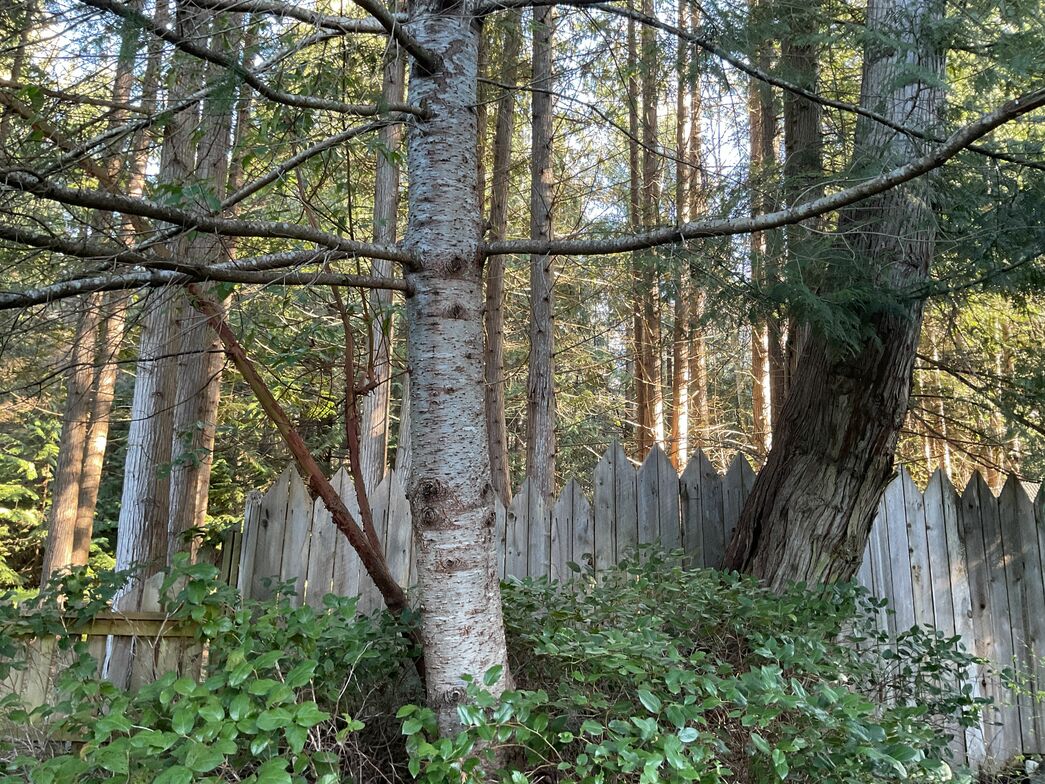
In our back yard we have three trees that are all close beside each other, and they stand sentinel over the pond. A great old grandmother cedar, a tall fir and a frail looking Arbutus. Their trunks are battle scarred from weather and construction, forced into odd shapes from drought and coastal gales. Underneath the surface in the rocky soil, their roots tangle around each other so much so, that they have to move together in order to grow, even just a little bit. But the other thing I notice about them, is that they have one big thing in common, no matter that they are all different and live with a dark tangled past - they all still reach for the sun.
Amen.
[1] https://www.workingpreacher.org/commentaries/revised-common-lectionary/second-sunday-of-easter/commentary-on-1-peter-13-9-5