Are we disciples - or "pew potatoes?!"

Well, don’t just stand there - do something! We’ve all heard that expression, along with its Christian bumper-sticker version: Jesus is coming - look busy!
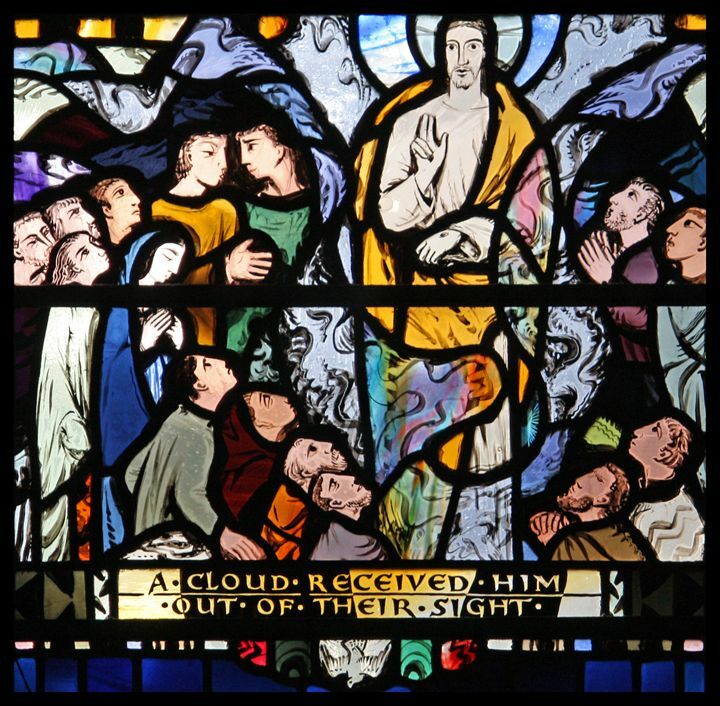
I couldn’t help but think of those words when listening to our first lesson from Acts, when the disciples are marvelling at Jesus’s disappearance into a cloud and suddenly two men in white show up and seem to say "Well, what are you standing around for?"
I have to say, though, in this instance I am not on the side of the angels."Why do you stand looking up towards heaven?," they ask. "This Jesus, who has been taken up from you into heaven, will come in the same way as you saw him go into heaven."
Well, if that’s the case, I think I, too, would be standing around staring up at the sky - I might just catch a glimpse of Jesus making his return! We can hardly blame the disciples for wondering what had just happened, and what would happen next.
Jesus understood that they would need some direction upon his Ascension. Although some of his teachings during his ministry had been enigmatic, on this point he was clear: the disciples were to go promptly to Jerusalem and, whatever they do, not leave there until they had received the gift of the Holy Spirit. He even gave them an uncharacteristically precise time frame: this would all happen, he says, "not many days from now."
Two thousand years on and we are again marking this kind of odd, stand-alone period between the Ascension of Christ on the 40th Day after Easter, and the coming of the Holy Spirit at Pentecost, 50 Days after Easter. But do we know what to do with it? The angels don’t want us standing here frozen, gazing up at the sky. Christ, on the other hand, says whatever you do, hold tight in Jerusalem. To call up another common expression, it sounds like a classic case of "hurry up and wait."
And indeed, perhaps that’s what we are to do. But as we know well from our other "waiting" seasons in the church year, waiting on the Lord is not a passive act. In Advent and in Lent, we actively attempt to quiet the other voices in our lives to prepare our hearts for the revelation of God’s love.
And as the pace of life quickens, turning away from all that demands our attention to make room for God is more critical than ever.
Just yesterday, I decided to tidy up my primary email inbox, not the one I use for church life, but for domestic life. I admit it’s a task I haven’t paid too much attention to in the past couple of years. To begin, I sorted them so that all the messages were automatically listed alphabetically by sender. As most of them were marketing emails from various companies and organizations, this enabled me to select and delete them in great bunches. Well, within a few minutes I had deleted well over 4,000 messages - and that was just from the senders beginning with A! I realized that if I wanted to get this sermon finished, I had better leave the rest of the alphabet for later.
Now just think - I may not have read all those 4,000 emails, but each of their shrill or seductive subject lines had captured my attention, if only briefly, as one by one they dropped into my inbox. Multiply that kind of distraction by all the other input and stimulus coming our way over the course of a day, and before long our inner space in no longer our own - let alone God’s.
What we pay attention to forms our thoughts, our spirit and our desires. I’ve noticed the word "curated" has become more popular in recent years, perhaps because the onslaught of information and choice that impacts us in these technological times requires us to be far more intentional in how we experience the world around us. So in partial answer to my email superhighway, I decided to create another, "secret" email address that I will use for my "curated" correspondence - and it definitely won’t go out to any businesses or mass marketers.
So I wonder how we might use this pre-Pentecost time to curate our relationship with the Divine, to make us ready not just to notice and receive the Holy Spirit, but to act on it?
I have been reading a book by Dallas Willard, the late American professor of philosophy whose many books on spiritual formation around the turn of the 21st century have since become modern Christian classics.
In his Great Commission, the resurrected Jesus instructed his followers to go make disciples in all the nations. However, Willard’s book, The Great Omission, points out that for too long the Church has failed to foster true disciples within its own ranks. He doesn’t pull any punches when he says:
…disciples of Jesus are people who do not just profess certain views as their own but apply their growing understanding of life in the Kingdom of the Heavens to every aspect of their life on earth. In contrast, the governing assumption today, among professing Christians, is that we can be "Christians" forever and never become disciples. (p xi)
Later, and again graphically, he says:
This "heresy" has created the impression that it is quite reasonable to be a "vampire Christian." One [who] in effect says to Jesus, "I’d like a little of your blood, please. But I don’t care to be your student or have your character. In fact, won’t you just excuse me while I get on with my life, and I’ll see you in heaven." But can we really imagine that this is an approach that Jesus finds acceptable?
Willard was writing during those years of the rising religious right in the United States and, indeed, we see the ugliest fruits of the non-discipled life in the unsettling surge of Christian nationalism. But none of us, however good or kind we may be, are exempt from the need to periodically pause and ask ourselves if we are growing more like Jesus, or less, or whether, tellingly, it’s been months or more since we’ve even thought to ask ourselves the question.
I have otherwhere heard Willard quoted as saying that there are two questions a church must ask itself: What is our plan for creating disciples? And, how’s that plan working out?
Those are indeed good questions for a church, but they are very good questions to ask ourselves as well. What’s my plan for becoming a better disciple? And how’s that plan working out?
A family from our diocese is currently in Ukraine. Mom and Dad have travelled from North Vancouver to help their university-aged son settle into a four-month volunteer post supporting wounded soldiers in hospital. It is not hard to see the courageous, Jesus-shaped faith that calls them there.
But how you react when someone zips up and steals the parking spot you’re waiting for can be just as indicative as to where we are on our Christian journey. (Speaking from recent personal experience! I think I landed a solid B-.)
Committed discipleship shows itself in the quality of presence we bring to friend and stranger alike. It shows itself in the decisions we make, both extraordinary and every day. It means sharing our gifts and resources with an ever-expanding circle of humanity and ecology, not just aiming to make sure we’re OK, or our kids are OK, or that the people who think or look like us are OK, but that thanks to God working through us, we are all OK.
It’s a tall order. But that’s why we get the Holy Spirit to help us out. And that’s why we have each other to help us out. Right now, there are all sorts of ways we can be renewing our hearts and minds as we prepare for Pentecost and beyond.
On our social media feed, Jenn is sharing the Archbishop of Canterbury’s devotional for these nine days between Ascension Thursday and Pentecost. For 10 years, Christians from around the globe, from all denominations and none, have used this short mini-season to take part in a program of prayer called Thy Kingdom Come. The idea is that every day we pray for five people who have yet to come to faith in Christ. There’s a great little video about it that I will post with this sermon online. My strong suggestion would be that at the top of the list, we write our own name as well and pray for our personal growth as genuine, life-giving disciples of Christ.
We’ll also be lifted up by a wonderfully inspiring Pentecost service next week, complete with Henry and Alison’s confirmations, and Archbishop John’s blessing of the firefighters.
But wait! There’s more. The weekend following is the Diocesan Mission Conference, and I enthusiastically urge you to attend. Bishop Michael Curry, former head of the Episcopal Church in the United States, is a dynamic and inspiring speaker. So join us at the mass choir sing on Friday night at the Cathedral, and/or take part in the Saturday event at the synod office. Hearing our faith celebrated in a variety of voices and venues is a great way to renew our hearts and minds.
Or you might decide to learn more about spiritual formation in a book like the one I’m reading by Dallas Willard. He offers up a helpful image for what it takes to turn us into better disciples, and he calls it the Golden Triangle.
On one side is the practice of faithfully accepting everyday problems with patience and grace. On the second side is living in the Spirit - consciously seeking and interacting with God’s spirit both inside us and around us. The third side of the triangle, he says, is made up of the spiritual disciplines - practices such as prayer, learning, worship and taking Sabbath rest.
He assures us that the three sides of the triangle, all working together, "will certainly bring us to ever-increasing Christ-likeness" (p. 30). And, as an aside, I have to say I love the frank term he uses for those of us who don’t take our spiritual formation seriously enough - he calls us out as "pew potatoes" (p.61). That’s an image I will remember!
Fortunately, it’s never too early or too late to commit, or re-commit, to walking ever more closely with Jesus. To desire to be a disciple not just in name, but increasingly in practice. To bring Christ’s light to more and more dark corners, in a way that comforts, challenges, and attracts others.
As we celebrate Christ’s Ascension today, perhaps of us, too, has an angel at our side right now, asking us why we are standing around, looking up at heaven. The work is not there - it is here on Earth, and it is entrusted to all of us. May the week ahead ready us to receive again the Spirit that equips us to do more than we can ask or imagine. Amen!
Image attribution:
Ascension, from Art in the Christian Tradition, a project of the Vanderbilt University Divinity Library, Nashville, TN. https://act.library.vanderbilt.edu/artworks/56525 [retrieved May 17, 2026]. Original source: https://www.flickr.com/photos/paullew/3558979922/.