In whose name will we create?

It’s Saturday night. Four people in four different countries sit in front of their computer screens. A young couple in Turkey—refugees—trying to make their way to Canada, have hit yet another roadblock in their application, made worse by the fact that their decision letter isn’t written in any of the four languages they speak. Desperate to meet the deadline for their appeal, they plug the letter into Google Translate. They breathe a sigh of relief, and begin their reply.
A pastor in London, England sits in front of her screen the night before she’s scheduled to preach. It’s been a long week. Her kids were home sick from school. There was an emergency in the parish. She hasn’t had time to sit down and write. She looks at the ChatGBT shortcut on her home page. Would it be so bad? Just this once?
A resident of Sturgeon Lake Cree Nation in Northern Alberta gets a notification on his phone from the local band council. A ‘cease and desist’ order has been issued saying, “No” to the proposed Wonder Valley AI data centre that would draw 65 million litres of fresh water a day from the nearby Smoky River.
These four people have something in common: all of them have the use of AI literally at their fingertips. Pope Leo recently issued an encyclical on “safeguarding the human person in the time of artificial intelligence.” An encyclical “is an official pastoral letter written by the Pope and addressed to all Roman Catholic bishops, the broader church, or all ‘people of good will’. Its purpose is to teach, guide, or clarify the Church’s official stance on matters of doctrine, morals, or social issues.” We might say it serves a similar function as, say, Paul’s letters to the Corinthians, though we wouldn’t necessarily weigh the Pope’s encyclicals the same as holy scripture.
In Pope Leo’s encyclical he refers to the time we’re living in as “a new industrial revolution fuelled by artificial intelligence.” He reflects on the use of AI and its very real repercussions (some might say advantages) in society, work, war, and education. His chief concern is that humanity and the natural world are increasingly subject to and subjects of AI, and not the other way around. That, “the main engines of development are private . . . endowed with resources and capacity for action greater than those of many governments . . . that AI cannot be left in the hands of a few, wealthy industry leaders.”
Local communities “must not be reduced to passive recipients of decisions made elsewhere; they must be able to contribute to discernment and oversight,” Leo writes. “Workers, teachers, scientists and faith communities need to be brought into the conversation. . . . International organizations and states must also step in to regulate AI, with special attention to the poor and vulnerable.” He talks about disarming AI, about “the children being forced into mines to gather the minerals necessary for AI development,” how “No algorithm can make war morally acceptable” (referencing AI-led weapon targeting where civilians have been misidentified as active combatants).
But what of the ways AI does serve humanity, helping, for example, refugees navigate paperwork even the most expert English speakers would find challenging? What about the tired parent with little time at the end of a week relieved that they no longer have to fight with ClipArt and Microsoft Word to make a poster for their child’s upcoming soccer social? What about AI-supported devices changing the lives of people with disabilities who use alternative communication systems?
Pope Leo stresses that “Disarming does not mean renouncing technology, but preventing it from dominating humanity. It means removing it from monopolies, making it debatable, refutable, and therefore habitable, restoring within it the plurality of human cultures and ways of life.” Which is exactly why the Church, why Christians need to be part of this conversation. We can’t and we mustn’t draw the blinds on AI.
As I reflected on Pope Leo’s encyclical this week and his invitation to Christians and “all people of good will” to safeguard the human person in the time of artificial intelligence, two things came to mind. First, a pledge that’s been circulating called The Saint Dunstan Pledge for Preachers. The pledge distinguishes between generative and non-generative AI and its use in sermons (or any form of writing, art, or making for that matter). Generative AI is what I referred to earlier: asking ChatGBT to write your sermon (or your essay or your journal article) and then passing it off as your own work. Non-generative AI includes things like recording voice memos of sermon drafts and asking AI to transcribe them; text-to-speech technology that’ll read a document aloud; spellcheck; and Google searches.
The Saint Dunstan Pledge invites preachers to use their own words; to quote words written or spoken by other people; to find and evaluate their own sources, and to cite them; recognizing that as preachers we have been “entrusted with the task of preaching the Gospel, the Good News of Jesus Christ, and this requires [our] effort, [our] prayers, and whatever skill [we] may have” to glorify God. I would add that, if or when we use generative AI, that we acknowledge—be transparent that that’s what we’re doing.
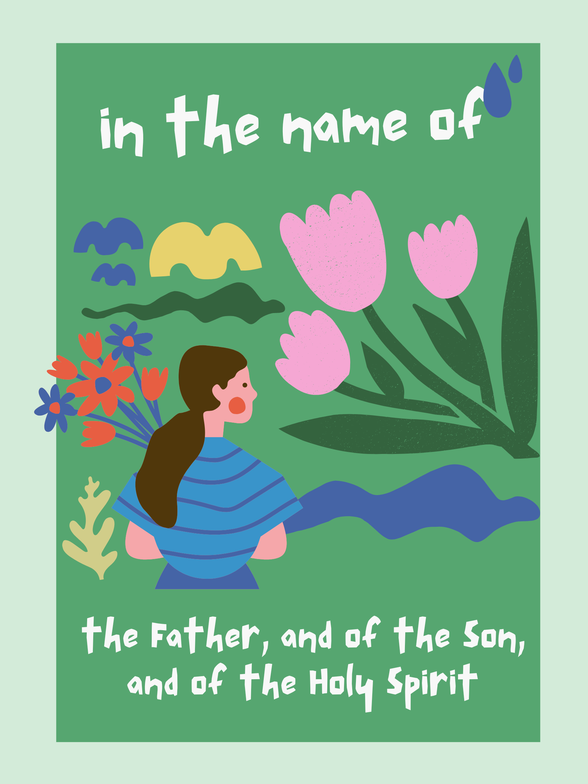
The second thing that came to mind as I was reflecting on Pope Leo’s encyclical this week was a question. As we consider this new industrial revolution fuelled by AI, in whose name will we create? It’s a question that I hear in Jesus’ mandate to the disciples in today’s gospel reading. He sends them “to go and make disciples of all nations” to go and create. He reminds them that they go, not in the name of Big Tech, or in the name of any one nation or ethnicity alone, but in the name of God: Father, Son, and Holy Spirit (Creator, Redeemer, and Sustainer as we sometimes refer to the Trinity). He tells them that, as they build this brave new world, as they tend to what will soon become explosive growth in the Jesus movement, that they are to obey everything Jesus taught. They are to love God with all their soul, mind, heart, and strength (to recognize God as the author and Source of all life), and to love their neighbour as themselves (to make sure, for example, that technology assists rather than exploits humanity).
Today, Arthur will receive the sacrament of baptism in that very name: the name of the Father and of the Son and of the Holy Spirit. Today, Arthur will be sent into the world to make . . . to create in the name of the Triune God. Do you know, Arthur’s first Sunday at St Clement’s was the Sunday where, during the children’s talk, we looked at AI generated and non-AI generated images and talked about how we could tell the difference? After the service, Arthur shared with us that he was off to AI camp the next day. I give thanks to God for brilliant minds like Arthur, at the AI table. I give thanks that the Church has entered the Chat in discerning young people who seek Christian faith as they seek to engage the world around them. Bless you, Arthur. You are a gift to the Church. You are a gift from God. You are sent this day in the name of the One, Holy, Undivided Trinity. Amen.
Works referenced:
Claire Giangravè and Jack Jenkins, “The five main takeaways from Pope Leo’s encyclical on AI,” in Religion News Service accessed online on 29 May 2026.
His Holiness Pope Leo XIV, “On safeguarding the human person in the time of artificial intelligence,” in The Holy See: Encyclicals, accessed online on 29 May 2026.
Image created using a template from Canva Non-Profit: Take Care Creative