Doing hard things: Historical Peacebuilders

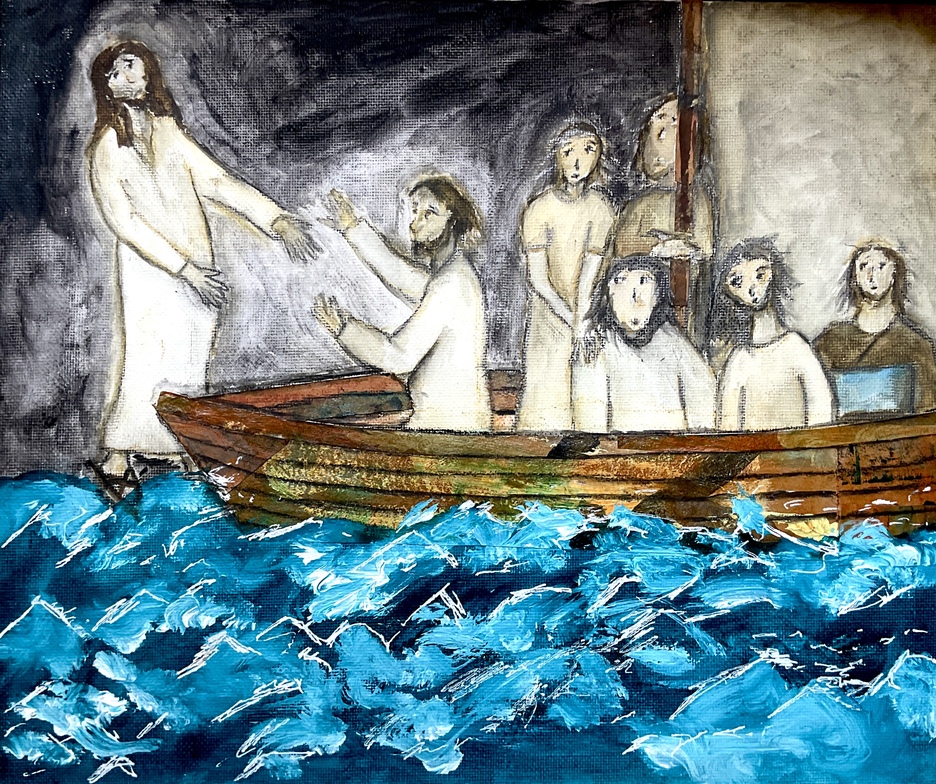
Eleventh Sunday after Pentecost
Gen 37:1-4, 12-28; Ps 105:1-6, 16-22, 45c; Rom 10:5-15; Mt 14:22-33
When I began to write this sermon, I looked at the Gospel many different ways; I painted it, and I read all around it. I read many other people's takes on why or why not to focus on Peter's fear. Having come freshly from a study of the synoptic gospels at VST, I can tell you that yes, there are many ways to talk about the passage we heard today, including the fact that it doesn't appear in Mark, most probably the first gospel written, but I won't go down that rabbit hole!
Some scholarly writers say it is too easy to focus on Peter's fear, but easy or not, that's right where I'm going to start, because it is something we can all relate to, something we all wrestle with, and it gives me a good place to share a story with you, so here we go. And please note, this is my own family's experience. So, it is just one way.
Perhaps you've heard me talk about my family's weaving history, and the fact that I learned how to weave from the chief of the Squamish Nation, Janice George and her husband, my cousin Buddy Joseph. My aunties were Weavers going way back, and you've probably seen pictures of my auntie Haxt'n that I've posted before, but I wanted to tell you a different story today, and it's the one where I sold my weaving loom.
It just became too hard for my shoulders to continue weaving large-sized pieces on a big 4-foot loom, but I'm happy that I learned how to do it, and I am sorry that I had to stop because my shoulders were so sore. I'm ready to let it go now. And I started to wonder if the pain was in part the weight of a burden that I'd been carrying too.
The burden I'm speaking about is trying so hard to fit historical truth into modern times. Struggling to be a weaver, when my body can't be a weaver, living a past that doesn't fit with my life today. I feel ready to let go of a lot that this loom represents.
Thankfully, there is another route I can follow from the past, which to me feels more natural in my bones - my grannies were also peacebuilders. And even though most of my family were taken to residential schools and Indian day schools and even convents to be raised when there was no money to feed 10 children, many still ended up being peacebuilders, and Christian peacebuilders at that. Granny Siamelaht was a peacemaker; a newspaper article about her from 1944 says she "counselled her tribe to accept Christianity and establish a Catholic mission on the North Shore." I struggled with this at first, but I believe she saw this as a positive way to bring the cultures together.
Once it was built, she was a faithful congregant at Saint Paul's Indian Church, and my family afterwards all parishioners at Holy Rosary in Vancouver, and they always worked to bring people to the church despite the fact that it was that the church that took their children to residential school or they themselves grew up in one of those places. In fact, their faith helped them live with the consequences born of their experiences.
But I should clarify something here and correct myself - it wasn't God or Jesus that took Granny Siahmelat's children. It was the children’s father. He took the girls away when they were toddlers; he wanted the Indian to be removed from them so they might fit into the new world that was being built around them. So, at the time, I believe that what my granny felt was nothing against God or Jesus or the Bible or her church specifically, but it was appropriately directed to the man, the legal system, which she fought to change, and the other people swirling around that upheld his beliefs. She continued to serve the church and stayed true to her faith, even forgiving the man and the law who took her children. We must untangle the past to see the truth of what happened. I think sometimes we forget that and just clump everything together into one statement because it's easier.
Her daughter, my granny Annie, like many, somehow even managed to hold on to her Squamish snichim, her language, through 13 years of residential school at St. Mary's, whispering it silently to her sister and their interred cohort. She remembered it so well that when was released, she also became a peacemaker, and she worked with her mother, the ethnologist professor Charles Hill-Tout - and the Squamish Nation as a courtroom interpreter - to help correctly translate Indigenous history and Culture as far as they could. So, while I come from a family of Weavers, my more direct line is a family of peacebuilders, women who translated the past into the present, who showed us all how to be peacebuilders in really hard times.
OK so what does this have to do with the gospel of mark and the boat, well, quite a lot. I realised, doing hard things like being peacebuilders, fighting for justice in hard times and defending those who have no voice, these are all very hard things, and what is required more than anything is faith, and faith together with others.
Why do you doubt me, Peter? Jesus asked - for without faith and belief, distracted by the wind, Peter started to sink. And so will we. Once when I was having an especially hard time with the yoke of discernment, our Priest Helen said to me, the yoke of the Lord is light - and I when I realized that the work was not directly on my shoulders, I was instead drowning under a different and distracting yoke, I was able to stand straight and continue on with my work, fuelled by the holy spirit, knowing that yes, that weight is given over to Jesus, and he is carrying, and still carries my burdens.
When I look back, I know that my family had this Christian faith while doing very hard things. And it was a very hard, staunch Roman Catholic faith that didn't take away from their cultural traditions or beliefs; Jesus never asked that of them. What their faith through the hardest of times gave them was the ability to face those hard times without shouldering the burden of the weighty things they stood for, which was ensuring they were heard in the midst of a growing, loud and noisy city.
There is still a lot for us to untangle during this period of reconciliation, but as Mr. Roger's always said of his neighbourhood, look to the helpers and the peacebuilders, look to those who have undergone or who are going through hard times then and now; they can be our role models, and I believe they will help us through our own difficulties.
And speaking of old TV - Sparky and I just watched Jeremiah Johnston, a really old movie with Robert Redford and a lot of actors dressed up to look like Indians. In one scene, when he is told that the Indigenous People they saw were 'well educated', taught by French Missionaries, Jeremiah asks: "Christian Indians?" and the other character responds: "Lots of them!" And I thought yes, yay, lots of us!
Like today, some Indigenous families relied on their Christian faith to see them through, and there are more of us than you might think - maybe we can be examples of a possible way forward, just as Peter was an example for the other disciples in the boat.
Amen
Painting by Jenn Ashton 2026