Giving thanks in all weather, whatever may come

By Thanksgiving Sunday, we’re all mostly settled into our different autumn routines. Depending on one’s circumstances, we may have joined an exercise class, entered a new grade at school, or be planting bulbs in the garden. But one custom we all, I think, share in the weeks of September is answering the frequently posed question, "So, how was your summer?"
The brief answer many of us fall back on is something like, "Great, thanks — yours?" This year, though, I found it surprisingly difficult to come up with an answer that was similarly succinct, but also felt true. I took great satisfaction in finally arriving at the one descriptor that summed it all up: My summer, I decided, had been "unsettled" — and I found my spirit had been as well.
This summer I learned that apparently I need life to be predictable before I can relax and gratefully enjoy it. My patio chairs didn’t make it out until mid-July, not because we didn’t have sunny days before then - we did, quite a few - but because there weren’t enough of them in a row to make the effort seem worthwhile. After all, why set everything up today if I’m going to have to pull all the cushions back under cover tomorrow? So I would enjoy the afternoon sunshine from my home office window instead - aware that I was missing out on the full experience, but mulishly resistant to doing anything about it.
This feeling persisted into our family’s August long weekend at Camp Artaban. We had been extraordinarily fortunate in having unbroken sunny weather in each of the previous four years, years in which we pulled our camp chairs into a big circle on the grass and used it as the hub from which we could take part in any of the outdoor activities on offer.
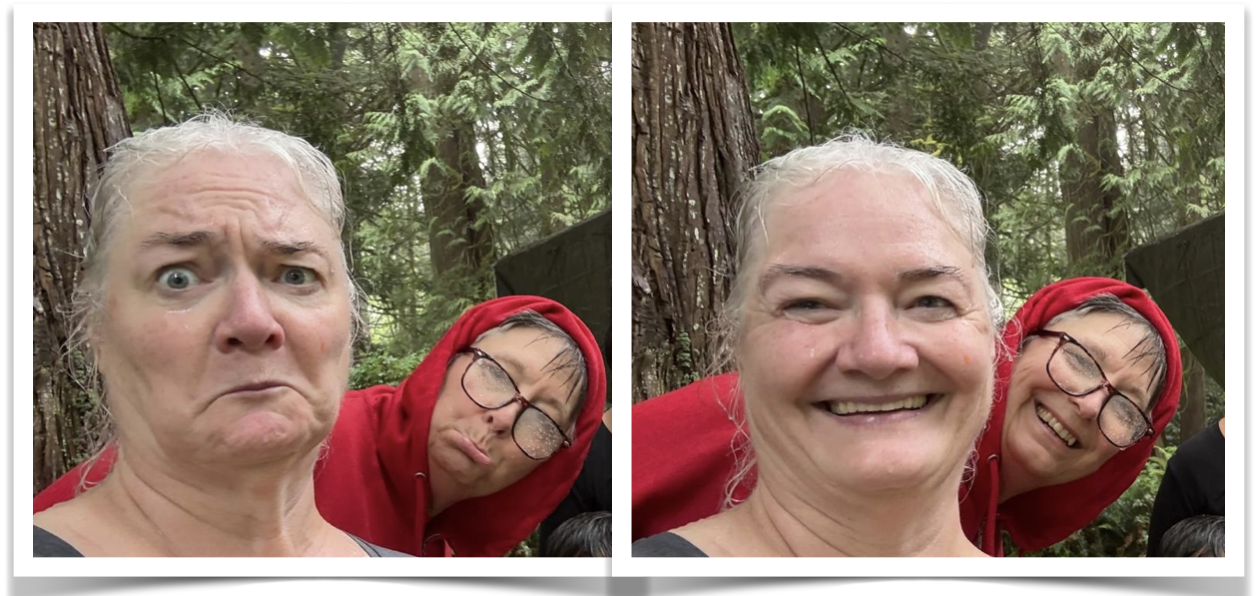
This summer, the mixed weather forecast meant we had to pack everything from rain capes to swim suits - and we had the chance to use them all, usually in the same day! But I found it was hard to really settle into anything, even just reading my book, when I couldn’t sense if the sun or the rain would last for one hour or 10. Anything we did predict was destined to be wrong - on the Sunday we confidently set out on a hike under sunny skies only to return just 15 minutes later, drenched to the skin!
Beyond the slightly odd weather, a couple of family health issues that bookended the summer and our communal worry of wildfires also added to a restless sense of unease that was hard to shake.
All of this taught me (yet again!) that I am not as spiritually developed as I may have hoped. It seems I can’t properly stop and enjoy a beautiful sunny day unless I am confident there are more to come. I am perhaps like the disciple Peter, whose first inclination when he witnessed the transfiguration of Christ on the mountain, wasn’t simply to watch and wonder, but to quickly suggest building tents so the moment would never end. Oh, Peter, I can relate!
We are, after all, a society that has expected the good times to keep rolling. Over the past decades, life expectancies have risen on a steady trajectory. Incomes have increased. Travel options and other opportunities multiplied. This wasn’t true for everyone, of course - many couldn’t or didn’t have a foothold into those good times, and we often closed our eyes to that. But it was true for enough of us that it somehow felt like general peace and stability were here to stay.
We now live in more uncertain times - and perhaps many of you, too, have felt "unsettled" these past months, for reasons far more significant than the summer weather. But noticing my need to be assured of sunshine, not just today but in days to come, reminded me that trying to control tomorrow can simply rob me of gratitude for today.
And so we come to today’s celebration of Thanksgiving, or, as it is traditionally known, Harvest Thanksgiving, a time to give thanks for the bounty of the fields and farms.
I thought about that word, "harvest," and what it means. It is, of course, both a noun and a verb. We use it to refer to crops, but we can also think of all the other goods and intangible resources with which we surround ourselves.
When I think of harvesting as a verb, I think in terms of relationship and interdependence - of working within the human, economic, and natural systems of which I am part. I think of gathering in something that one has a reasonable right to, in quantities that do not harm or deplete the survival or well-being of others or the Earth.We can contrast that with the over-harvesting of all kinds of resources, with its accompanying undertones of greed and all its negative knock-on effects. Harvesting is about wise preparation; over-harvesting is the mad rush of self-focused people stockpiling vast cases of toilet paper at the start of the pandemic.
Harvest Thanksgiving isn’t about stocking our metaphorical shelves so high we start believing that hard times will never come. Harvest Thanksgiving is being thankful for the blessings that will see us through the cold that we know will come. We give thanks together as a parish community, because it’s as a community that we are stronger in faith and fortitude, whatever wintry blasts may lie ahead.
The Bible is full of counsel against worrying about tomorrow. The Hebrews in the desert were only allowed to collect manna enough for one day - hoarding any more than that would cause it to spoil. Jesus taught us to pray for our daily bread - not for overflowing freezers of excess loaves getting increasingly freezer-burnt.
Knowing that today’s bounty, today’s sunshine, or today’s good health won’t last forever should be all the more reason to give thanks for it today. So if rain is coming tomorrow, I had better put out my patio furniture now, and invite a friend over for lemonade.
A favourite harvest-time hymn tells us that all good gifts around us are sent from heaven above - and today especially we are called to stop and remember that. Letting thoughts of tomorrow eat into our appreciation for today is kind of like getting a birthday present from someone special but leaving it partially unwrapped on the counter.
Being a poor receiver can also make us a poor giver. Getting lost in our own anxieties turns us inward; when we forget to notice all we have, we tend not to notice those who have far less. Practising gratitude not only makes us more aware of our many blessings, it stirs in us the desire to share them. When we trust we have enough, we want everyone to have enough.
Paul’s epistle to the Corinthians today counsels generosity; his letter gives us that now-immortal expression, "God loves a cheerful giver." The first line of the reading, though, also speaks to me of what it means to be generous in our thanks.
"The point is this," Paul says, "the one who sows sparingly will also reap sparingly, and the one who sows bountifully will also reap bountifully."
When we are like the nine lepers in the gospel who run off, forgetting to show - or sow - gratitude, we may stop seeing all the things we have to be grateful for. If we send up frequent prayers of thanks, though - for a paycheque, for a new friend, for an old friend, for a warm coat on a cold day - I suspect our harvest of blessings will be bountiful indeed, and that more and more we will want to be a blessing to others.
When I finally gave up on having a "normal" summer, I was better able to be present in the moment, and grateful for the simple joys it brought: the impromptu catch-up with a good friend, lying on the grass in Merritt with my eyes closed, and feeling like the kid I was when I first started visiting my cousins up there. Whatever the weather brings, in good times and bad, we are surrounded with reasons to be grateful.
So, thank we all our God - with hearts, and hands, and voices, today and every day. Amen!
Photo above is cousins Christie and Peggy turning their frown upside down after being caught in a rainstorm at Camp Artaban.