God the liberator - not the landlord

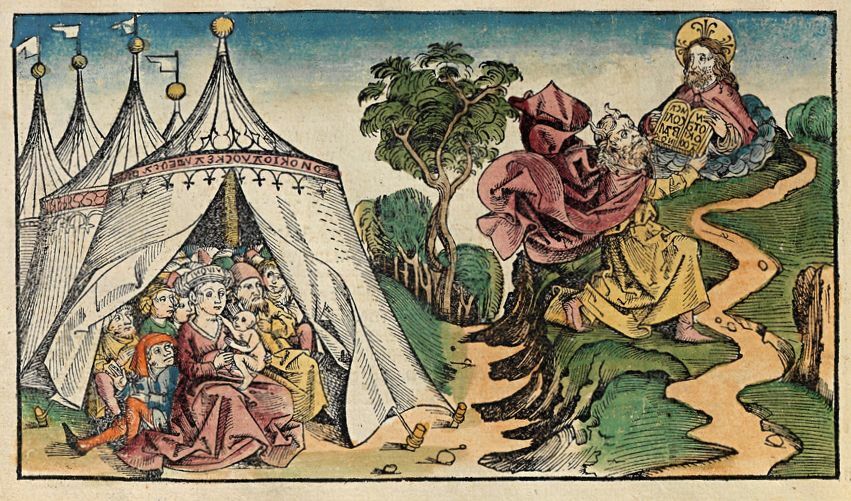
When people hear “The Ten Commandments”, what image pops in their mind. For some, it is the scene from the movie “The Ten Commandments” where Charleton Heston’s Moses brings down the two stone tablets. Other people might think of the Ten Commandments controversy in the United States where people argue of whether they should be posted in public spaces. To many people, and probably many Christians, the Ten Commandments are seen as ironclad rules imposed by God, in the traditional picture of who most people think God looks like, a stern Father, a rigid judge, someone looking down on us. It doesn’t help that the Commandments are framed as negative “You shall not” rather than “You shall.”
But the Commandments in Exodus do not have to be seen as rigid rules imposed by an impersonal and stoic judge from on high. And this is where the lectionary helps us, in past Sundays, we are reminded in our First Readings of God’s faithfulness to God’s people. The first verse of our reading today recalls God’s freeing the people from enslavement in Egypt, but the last two Sundays are also crucial: God sends manna from heaven to feed the people when they are starving, God sends water from the rock to quench the thirst of the people. This is God who liberates, feeds and shelters God’s people. There are parts of our tradition that present law and grace as complete opposites, and there is a place for that understanding: we know of where legalism can kill and oppress. But I like to offer that at least in the original context, the law was understood, not as the opposite of grace, but a response to grace.
God has set us free from slavery, God feeds us in the wilderness, God abides with us always. If we approach the Commandments from this angle, the laws become less like ironclad rules, and more like invitations to imitate the character of God. The commandment against idolatry is an invitation to trust in the Holy One who liberates and turn away from the humanmade idols that seek to enslave, oppress and destroy us and all creation. The commandment against taking God’s name in vain might be very relevant to us today, in a time where Christian nationalism seems to rear its ugly head both south of the border and yes, here in this land, we cannot use the name of the Liberating God of justice to enslave and oppress and do injustice to others. The commandment for sabbath rest invites us to rest in the one who shelters us, for as much as our work has its place, God does not see us ultimately as just workers, cogs in a machine. And the commandments for human relationships, four to ten invites us to consider that God has liberated us, not just as individuals, but as a people, as a community, and a just relationship with God cannot happen without a just relationship with each other. Enslavement and oppression turn us against each other, as we end up competing for the few scraps of mercy from whatever empire that is in charge.
God has set us free to be in right relationship with each other and in right relationship with her so that we are free to love, to heal, to be in communion.
God is less like a harsh judge, but a loving parent who frees her children, feeds her children, and invites them to enact her way of love in the household of God.
With that in mind, it might be fruitful to look at our gospel. It is the story framed as the landlord and the tenants, the traditional view is that God is the landlord, the tenants are God’s people, the enslaved persons in the beginning of the parable are the prophets who are rejected, and the son is Jesus. From my 21st century eyes, Matthew’s parables which depict a king or a Lord which is traditionally understood as God, are unsettling.
But what is striking to me about this parable, is the different reactions between the landlord and the tenant. The landlord repeatedly gives chance after chance to the tenants, often foolishly so. The tenants respond with violence. Jesus at the end of the parable, asks his listeners what they think the landlord will do at the end. And it is noteworthy that Jesus does not himself say that the landlord will punish the tenants violently, it is his listeners who give that opinion. The tenants expect violence from the landlord and so they act with violence.
But what if God isn’t a landlord. What if God is a loving mother, father or shepherd, who liberates, feeds and shelters us, God who acts generously and loving towards us, and invites that generosity and love in return, not out of any coercion, but because when we respond to that invitation, we end up living our true and abundant selves. That is where Paul reminds us that love is fulfilling the law, right relationship with God, with each other, with all creation isn’t a burden, or a cage, but the very root of our freedom and wholeness.
We are at the end so to speak of creation tide and Truth and reconciliation week. We are called of course to live in right relations with creation and work on truth and reconciliation all year round, this moment of the year is to highlight, to draw specific emphasis in the liturgical year. Part of it is learning and grappling with the truth, we have not lived in right relations with creation, and we have abused and sinned against our indigenous siblings, and those who speak truth to us now, might say that the harm and the consequences of that harm has not ended.
And yet the Holy One continues to come to us, not as a landlord looking to punish, not as an impersonal judge swiftly delivering our final verdict, but as the One who liberates us from every cage and sin, the One who still feeds us with the grace of our very real daily bread, and the spiritual bread of life, the One who sends Jesus to call us back into the flock of God, The One who sets us free to live in true communion, in loving God, loving neighbour, loving creation.
Set us free, O Liberating, Lifegiving, Loving God, and free us to live the true life of love with you, with each other, with all creation, through Jesus Christ, our Shepherd and True Vine of Life, Amen.
Image above:
Moses receiving the law, from the Nuremberg Chronicle, from Art in the Christian Tradition, a project of the Vanderbilt University Divinity Library, Nashville, TN. https://act.library.vanderbilt.edu/artworks/55138 [retrieved October 7, 2026]. Original source: http://commons.wikimedia.org/wiki/File:Nuremberg_chronicles_f_30v_2.png.