Turning the tide, swinging the story

13th Sunday after Pentecost – Year A
August 23, 2026
Last week Allison helped us unpack the story about Jesus and the Caananite woman who begs him to heal her daughter. It’s a passage that can be hard to digest, as it doesn’t seem to square with the Good Shepherd we know – at least until the end of it, when he tells the woman that her faith has made her well. But Allison noted that the story acts as a narrative hinge in the gospel of Matthew – after this encounter, Jesus expands his ministry radically, telling his disciples not to avoid the Gentiles but to take the love of God to all people.
As it turns out, there’s another kind of hinge in this week’s lesson from the Book of Exodus. When I was first reading it, I was curious to note that the two Hebrew midwives are specifically named in the text – sometimes, the meaning of a name, or the simple fact of being named amongst hosts of other unidentified people in the scriptures, points to an added layer of significance.
You may recall that at the end of the book of Genesis, the elderly Jacob and his sons were driven by famine to Egypt, where they were received and honoured by Jacob’s long-lost son, Joseph. The book of Exodus begins by naming these 12 sons, who go on to father the 12 tribes of Israel. Their population grows and grows to the point that the Israelites are seen as a potential threat to the Egyptians. To neutralize this possibility, Egyptian rulers put the Israelites into work gangs and force them into hard labour making bricks and working in fields.
Some scholars speculate this growth in the Hebrew, or Israelite, population took place over a period of about 300 years. And when the scriptures pick up the story again, the very first people named are Shiphrah and Puah, the two Hebrew midwives commanded by Pharoah to kill each and any boy born to a Hebrew woman. And these two midwives are a major hinge upon which the history of the Hebrew people turns.
About a thousand years ago, a famed Jewish rabbi noted that in this passage the word midwife is written using the active, not passive, form of the Hebrew word. One form was used when a midwife attends an uncomplicated birth; a different form would be used if the birth was challenging or complicated. We can understand well why Shiphrah and Puah are described with the active form of the word. Standing up to and blatantly disobeying Pharoah, midwifing the Hebrew people into a new future, would be risking everything.
The name, Shiphrah, by the way, means something like beauty, harmony, and clear skies. Puah is traced to a word that was often used to describe a shining, radiant manifestation of God. We see in these women a divinely inspired, shining act of civil disobedience that birthed the Hebrew people into a renewed, revitalized identity as the Children of God.
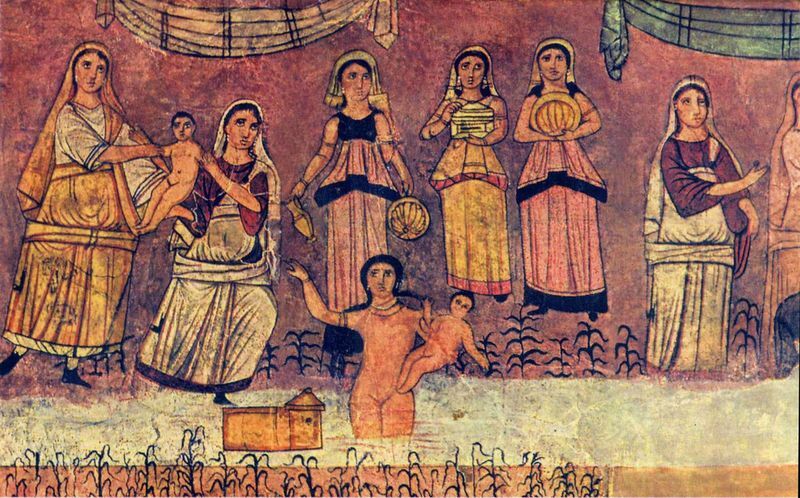
But this is a hinge with two parts. On one side we have these two midwives, working covertly and in great personal danger from within a system of oppression. Thanks to them, baby Moses was born safely. But after he was left in a basket of reeds to float along the banks of the River Nile, a very different person stepped in to save him - Pharoah’s daughter, who was operating within that very same system, but from a place of enormous privilege. We never learn her name. But like the midwives, she, too, stands up to her father’s rules and safeguards the life of the boy who would ultimately grow up to lead the Israelites to freedom.
So what might we take from this, besides being able to add Shiphrah, Puah, and a noble daughter to our long list of other women of courage and conviction who act as key players in the grand narrative of scripture?
Well, this story encourages me to remember that I, that we, are called on to manifest God’s love and compassion regardless of our own circumstances. Even if, like the midwives, I am facing huge challenges that may limit my range of resources, I can almost always do something to help others or make a positive difference in the situation.
Alternately, if I am on the pharoah’s daughter side of the hinge, I can use what I have to lighten the load of people in less peaceful or comfortable circumstances. Through charitable means, I can help meet the immediate needs of people who are struggling, and by raising my voice for justice I can help push our society to longer-term, more equitable sharing of opportunities, decision-making, and wealth. Through acts of charity and justice, Christians on both sides of the hinge are called to be agents of God’s shalom.
Taking up this holy work can rock our boats, risk our comfort, or, depending on one’s circumstances, be outright dangerous. I am reading a wonderful biography of Lilias Trotter, an English woman born in the latter part of the 19th century. She was a vastly talented, self-taught artist who had gained a mentor in John Ruskin, the leading art critic and culture-shaper of the time.
She was also filled with love for God and had vast energy for mission and ministry in and around London, roaming the streets at night to help women through the auspices of the newly formed YWCA.
Her love for beauty and colour took her on several trips to Northern Africa; she and a friend went on months-long camel journeys, tenting amidst the white and gold sand dunes of the deserts.
And her love for the people she met there ultimately guided her to set up a mission home in Algiers, where (much to the dismay of John Ruskin back in England), she forwent fame to live simply amongst the people of the city, learning the language, opening the home to guests of all variety, and constantly offering the hand of friendship. She still picked up her paintbrush to capture the natural scenes that spoke to her- and her talent is indeed remarkable - but she had closed the door on a pursuing a life in the arts. Her biographer tells us this was not a painless sacrifice; that Lilias still thought wistfully at times about the artistic vocation she was unable to realize as fully as she could have.
Lilias didn’t expect everyone to make life choices as vast as her own. But she did want people to sift through all the myriad options that life gives us, and, day by day, carefully discern which action we are called to take. The hard part, she said in a devotional pamphlet called "Focusing," isn’t so much in picking between a good and bad choice, but between the many good and honourable choices that might lie before us. Having experienced that dilemma herself, she fully understood the challenge. But her pamphlet urged its readers to stop being distracted, and to focus on the one true thing that will make the other paths drop away.
She wrote: "Turn full your soul’s vision to Jesus, and look and look at Him, and a strange dimness will come over all that is apart from Him…."
If those words sound familiar to you, it’s no wonder. Her pamphlet found its way to Helen Lemmel, who was inspired by these phrases to write her famous hymn, Turn Your Eyes Upon Jesus, in 1922.
The same challenge rings out in our gospel reading as well, when Jesus himself looks Simon Peter in the eye and asks: "But who do you say that I am?" In that moment, Peter sees Jesus in his fulness. He pledges his path to Jesus and let the things of the earth fall away. It is a commitment we are all asked to make, each and every day, even if God knows we will not be able to live up to it perfectly.
But I suggest we can work to develop what Lilias called a "posture of the soul." By cultivating focus, by seeking to be "quiet, and ready, and free," she said we can each be like a seed on the silvery grey globe of a dandelion’s head, waiting to be blown into the world. In ways big or small, she wrote, we can be ready to give ourselves away "at the moment when … inward preparedness and ….outward opportunity" meet.
Even 100 years ago, Lilias knew what a distracting world we live in, one full of temptations that can take us away from this vocation. I hope that being here in worship helps us stop and focus on our journey in Christ. What else in your life helps you turn your eyes toward Jesus? I would love to hear your thoughts on that.
I gave myself an added boost last year by participating in an excellent Christian formation book club, and I am going to sign up again this season. It runs from October to May, during which time four books are read and lots of online resources offered. If you’d like to join me, we can get a group rate and have some good chats with each other along the way. Please see me in the next couple of weeks if you’d like more information.
We all have different paths in life; we may walk roads that are terribly challenging, or we may be blessed with roads that are more smoothly paved. But in any situation, whether we are the Hebrew midwife or Pharaoh’s daughter, may God help us keep our focus on Jesus and, with power of the Spirit working in us, may we do infinitely more than we can ask or imagine to swing the world toward God’s liberating love.
***
Image above: Shiphrah, Puah, Jocheved, Miriam, Pharoah's Daughter, and the infant Moses, from Art in the Christian Tradition, a project of the Vanderbilt University Divinity Library, Nashville, TN. [retrieved August 24, 2026].