Forgive us our gunny sacks

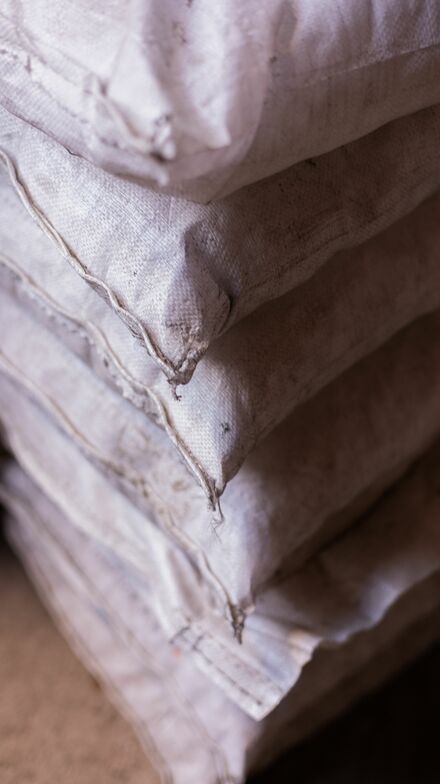
I wonder if you know the expression “gunnysacking?” I first learned it in my Psych 100 class in university. It’s stayed with me ever since. It’s when you slowly and silently build up a storehouse of grievances. We’re talking about the little things a person can hold on to for years.
The expression “gunnysacking” has some interesting origins. A gunny sack is a large bag made from jute, hemp, and flax. It’s used by farmers for hauling potatoes and when filled with sand, as flood prevention during heavy rainfall. And, who among us hasn’t hop, hop, hopped our way across a finish line in a burlap sac race? Gunny sacks are durable and hey, even kind of fun.
I looked up whether Jesus had gunny sacks in his time. I learned that no, they weren’t invented yet. What they did have in Jesus’ day was a near-equivalent fabric called sackcloth. Sackcloth, though, was a garment rather than a container and worn only when you were grieving or as penance for sin. As you can imagine, sackcloth is itchy, resembling the inner pain of grief or the inner discomfort of guilt. The thought of wearing a scratchy material longer than needed because you were deliberately choosing to hold on to something, this wasn’t exactly a first century ideal, so when it came to storing up the sins of your sibling, or your employee, or your tenant, or your neighbour, Jesus counselled his disciples to, well, not.
The tenant in today’s gospel owes their landlord a whole pile of rent: let’s say three burlap sacs worth. Instead of demanding that the debt be paid, the landlord says something akin to, “the world is full of inequality, inequality that disproportionately affects some more than others. Forget what you owe. Be set free.” But when the tenant sees their neighbour who owes them money, the tenant makes the neighbour pay back every last cent, even though a lesser debt is owed. The landlord gets wind of this and throws the ungrateful tenant out, torturing them until the original bill is paid.
“So my heavenly Father will also do to every one of you,” Jesus says, “if you do not forgive your brother or sister from your heart.”
Jesus is using hyperbole to make a point (Jesus does this a lot in the Gospels). Jesus is saying that if you want to follow the God who makes themself known through abundant forgiveness, you need to become the kind of person who is willing to forgive abundantly. What I love about this parable is that Jesus isn’t even talking about what we might consider to be more major sins. He isn’t talking about forgiving a neighbour who’s committed murder or a family member who’s robbed you of your inheritance. He’s talking about hoarding petty grievances, about gunnysacking, about choosing to wear an itchy sackcloth garment when you have no reason to be wearing it. It’s uncomfortable and a lot of time has passed and it’s probably time to do some laundry.
On this topic of holding on to grievances, I want to say that I get it: recovering gunny-sack, sackcloth-wearing diva reporting for duty. The gunny sack, the sackcloth is what’s often kept us safe. When we hold tight to that list of grievances, we have something we can defend ourselves with. When we continue to clothe ourselves in sackcloth, to hold on to guilt, or grief, whether our own or that of others, we don’t have to face the unknown that is moving on.
Gunny sacks are great for theological baggage, too. For the longest time, I’ve held on to the idea that forgiveness isn’t possible without repentance, that you can’t let go and let God unless the person who’s wronged you is willing to acknowledge their sin. My mind is changing on that. It’s reconciliation that’s impossible without repentance, but forgiveness, forgiveness is a gift from God that sets us free!
My wife reminded me last night of a famous Mark Twain quote. It goes “Anger is an acid that can do more harm to the vessel in which it is stored than to anything on which it is poured.” That’s the point of today’s gospel reading. It’s not up to us to withhold forgiveness. It’s not up to us to store up our neighbour’s sin. That’s God’s job, and remember what it is that God has done with that storehouse of sin. The line from the old Anglican Prayer Book says it all: “Blessing and glory and thanksgiving be unto thee Almighty God, our heavenly Father, who of thy tender mercy didst give thine only Son Jesus Christ to take our nature upon him, and to suffer death upon the Cross for our redemption; who made there, by his one oblation of himself once offered, a full, perfect, and sufficient sacrifice, oblation, and satisfaction, for the sins of the whole world.”
“A full, perfect, and sufficient sacrifice . . . once offered . . . for the sins of the world.”
Through Christ, that storehouse of sin has been cleared out. How much more, then, ought we to leave our storehouses at the altar?
Gunny sacks are for picnics and floodplains and potatoes. Sackcloth is a temporary garment, not a wardrobe staple, and neither were ever meant as holdalls for the human heart. Take note from the children among us returning to school, and leave this morning wearing a backpack instead. The backpack is the more useful vessel. It isn’t particularly durable and the zippers are forever breaking, but a backpack holds only what is needed for today: a packed lunch, a change of clothes, and maybe a set of pencil crayons. A backpack, for the most part, gets emptied and refilled, and if it doesn’t, the banana rotting at the bottom will soon start to smell and at some point you have to deal with it. Kind of like sin, huh? Amen.
Photo: Eyüpcan Timur, Canva for Non Profits