National Indigenous Day of Prayer

Today is Our National Indigenous Day of Prayer, and it's also Indigenous People’s Day inside of June which is National Indigenous History Month. I am always honoured to speak on these days, and especially this particular month as this is my first sermon as a deacon.
So, I'm not sure if this is going to be a sermon or a history lesson, we'll see where we end up. Just as we began with John 1 today, I figured we should also start close to the beginning of Canadian Indigenous history, back to when Canada was an infant before it was even a dominion. This is bit of history that perhaps some may not know, back when we lived in a fairly peaceful time, sort of side by side, Indigenous and settler. We're looking back here to 1763 and the Royal Proclamation of King George III. In part it reads:
And whereas it is just and reasonable, and essential to our Interest / that the several Nations or Tribes of Indians with whom We are connected, and who live under our Protection, should not be molested or disturbed in the Possession of such Parts of Our Dominions and Territories as, not having been ceded to or purchased by Us, are reserved to them / as their Hunting Grounds — [1]
It goes on to say that the lands we lived on were ours unless purchased or given, they ...are reserved to the said Indians.[2]
Of course, over time and the farther west the multitudes came, things changed to where almost everything was taken by the 'Crown', and we still have that term today, Crown Lands, if you want to look that up.[3]
I want to stop for a moment here and show you a couple of pictures, here is what the expansionists and settlers thought Canada looked like, this is a map from 1570 by a chap called Abraham Ortelius, called Theatre of the World, and you can see over here in North America - a vast empty landscape.
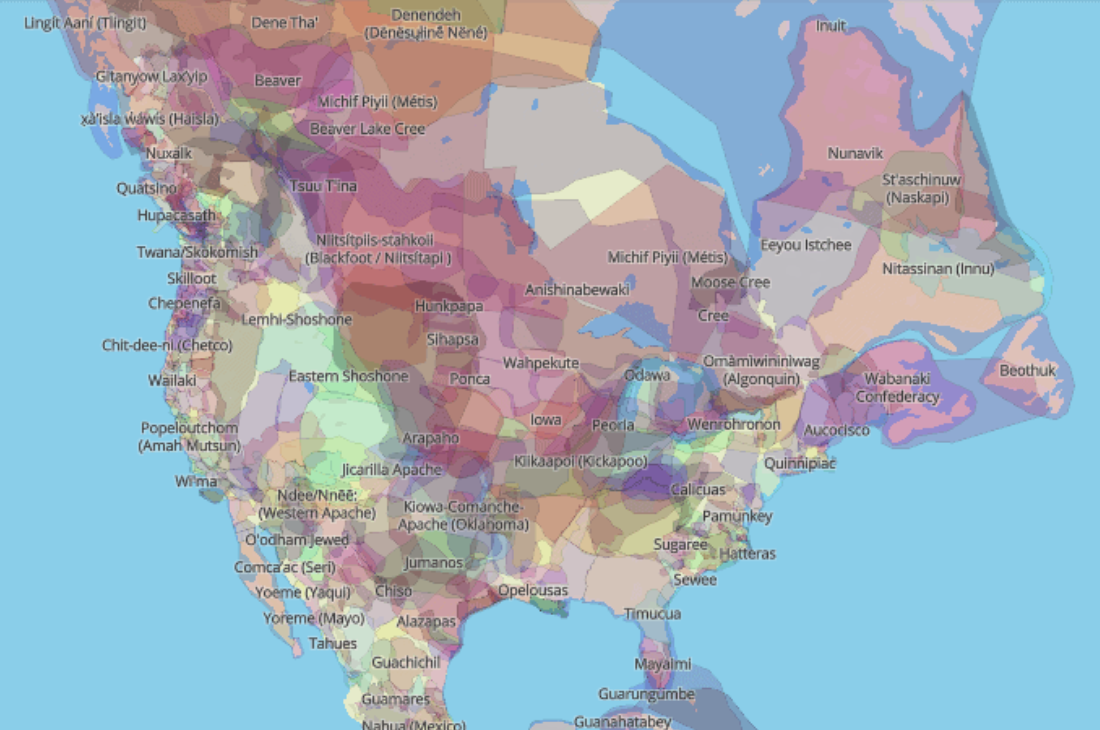
And then compare with this, with the reality: represented by this map, where on every part of the land lived a Nation already standing and thousands of years old, having a history, having a culture, a language, medicine, science, families and importantly futures, which they planned for, just like we do today.
Today when I hear the word Reconciliation, my mind now goes back to the 18th Century to a time when some of the Eastern Indigenous Nations were more or less respected and in some cases worked alongside the new populations. And even if not fully respected, because we were so different, then at the very least according to the Royal Proclamation (1763), we were meant to be free on our own lands to live our lives.
To get to a place of Reconciliation, a place where we can imagine backwards to how it might have been in 1763, from where we are now, is a hard task, because of all that has come in between that Proclamation and today. But it should be hard. It should be a thought provoking, darn-hard-thing, because there are no easy answers. It's going to be a tough process which can only be addressed by looking at the mechanics of that past to understand what truly happened along the way. To sort out who did what and why, to get to the truth. And we need to do it together, that's why God gave us each other.
I want to give you an example of one of the many things we are trying to mend within our Nations. In Indigenous culture, we are all part of creation, there is no separation or hierarchy between the stars, the water, the creatures, this leaf, and us. All equal and part of the land we live on. Our stories, our oral histories are land based teachings about places and nature, so when we were eventually stripped of our lands, removed from our lands, you can see that we lost part of ourselves. Unable to speak our language and share our places, our stories felt silent and many were lost. But we're trying to reclaim them.
Back to today's readings for a moment - Kristin Wendland, professor and Hebrew Bible Scholar at Wartland college in Iowa says, The chapters following Isaiah 40 address a tired and weary people who likely had some trouble imagining a new future.[4] I totally get that. We modern Indigenous are weary too because we carry the burden of a traumatic past, which along with many other aspects of that past, are still ingrained in our current society, this can sometimes prohibit forward movement and healing. We are as weary as those ancient Israelites, because they knew they had to move into another unrecognizable future; and because uncertainty is tiring and triggering.
But like many faith filled people in times of trouble, we held fast to the Creator God. When we were placed on different land, maybe the sky looked a bit different, but the stars still shone. We knew the Creator did not abandon us, and that is why we still hang on, we are still here and we are still hopeful.
And we know there is always hope to be found. There is hope that as we ourselves reconcile within our own Nations, we can reconnect to our Ancestors, and to our histories which were almost lost. And as we reconcile within ourselves, we hope to reach out and reconcile with others, but maybe on our own terms, maybe more slowly and carefully than might be expected of us, because trust building is at the forefront of this exercise, and that can take time. We don't know what our future looks like but we are finding new joy in uncovering old ways, and when we're ready we would love to share more things with you. We have some stuff to work through first, and that's just fact, so please think of this when you ask us to share and give before we are ready.[5]
Ok, that's your history lesson and now to also fulfill this as National Indigenous Day of Prayer, I would like to add a prayer I found at the Diocese of the Arctic, who asked: "When is the last time your church prayed on a Sunday for those ordinary people right there in the pews that God might be calling to be trained? (That's you!) Let's commit together to pray for those, from children to elders, who God will call to serve."
This is one of the ways we can act towards the reconciliation of Indigenous Peoples and the church, by making more people like me, to share what we know, share our stories forward, weaving a forever bond with you. To me that's what reconciliation looks like.
Please join me in this prayer for future Ministers:
Almighty God, we thank you that you raise up ordinary people in every generation to lead and serve your Church, and you give them the gifts they need to faithfully do your will. We pray for those here today who you are calling to serve you as priests and deacons; make them open to hear your voice, brave to ask others to pray for them, and humble to submit themselves to your Holy Word;
Father, by the Holy Spirit, send forth many labourers for the harvest, so that all may hear and know the love made known in Jesus Christ our Lord, in whose name we pray. Amen.
[1] George R, Proclamation, 7 October 1763 (3 Geo III), reprinted in RSC 1985, App II, No. 1.
[2] Ibid
[3] https://thecanadianencyclopedia.ca/en/article/crown-land
[4] https://www.workingpreacher.org/commentaries/revised-common-lectionary/fifth-sunday-after-epiphany-2/commentary-on-isaiah-4021-31-5
[5] https://theconversation.com/want-to-reach-out-to-an-indigenous-scholar-awesome-but-first-here-are-10-things-to-consider-168558