Like, baby, baby, baby, oh!

I was at a Goldeneyes game last Thursday. The Goldeneyes are Vancouver’s professional women’s hockey team. Many of the players are getting ready to represent their country at the Olympics—five will play for Team Canada. There’s nothing quite like a stadium full of people singing together at a hockey game—whether it’s the national anthem, or “Let’s go Goldeneyes!”, or the pop song that comes on over the loudspeaker to get the crowd going. At the game last week, there were these clusters of girls minor hockey teams in the stands. At one point, all you could hear was this wave of tweens (and their parents) singing, “Baby, baby, baby, oh! Like, baby, baby, baby, no! Like, baby, baby, baby, oh! I thought you’d always be mine, mine.” It was really quite something!
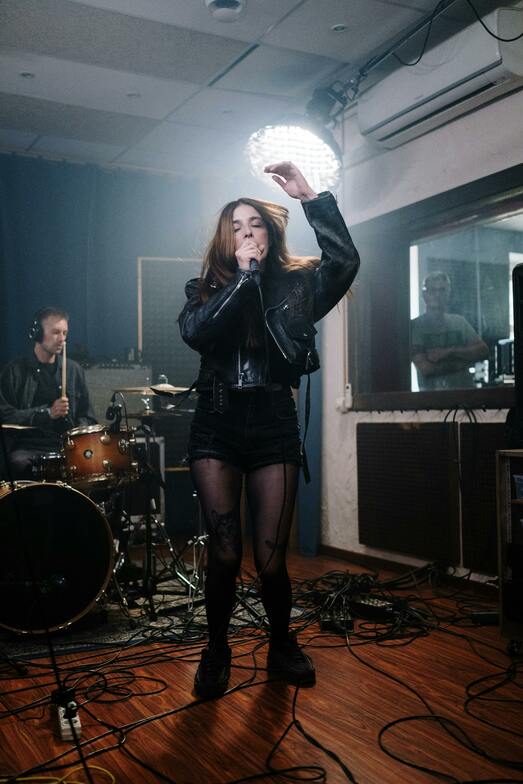
I wonder when was the last time you properly belted out a song? Like, full on not worrying what you sounded like? A friend of mine talks about the time she was at a youth conference in the UK. At one of the worship services, they were singing a praise song by the Australian singer and one time Pentecostal pastor Darlene Zschech. It’s called “Shout to the Lord”. My friend talks about this incredible sense of freedom she felt singing at the top of her lungs. So much so that she refers to “Shout to the Lord” and other praise songs from the 90s and early 2000s as “proper bangers.” The Paul Baloche song K--- sang last week absolutely falls into the category of proper banger.
Of course, not all of us find our voice in stadiums or Christian revivals. I was at home yesterday saying the morning office (daily prayers that we say in the Anglican tradition). Afterwards, I looked at my phone. I had a text from my spouse. She said, “Can you send me that song?”
I went into the living room to ask her what song, thinking it was something we’d been listening to in the car. She said, “The one you were just singing while you were praying.”
It was the Benedictus, the Song of Zechariah, a choral piece by St Martin’s Voices.
Bieber. Darlene Zschech. Paul Baloche. The Song of Zechariah. If I had to choose a single line of scripture to describe the spiritual experience of singing a really good song, here’s what I’d choose: “The people who walked in darkness have seen a great light; those who lived in a land of deep darkness—on them light has shined.”
That’s what it feels like to sing a really good song. It leaves you feeling hopeful. It leaves you feeling alive! It leaves you feeling like there is light in the darkness.
“The people who walked in darkness have seen a great light; those who lived in a land of deep darkness—on them light has shined.” The prophet Isaiah says these words. He is talking about darkness and light in a cosmic sense as well as on a local scale. He’s talking about the futility of the human condition—why is it we favour a land of deep darkness when another world is possible? Why do we continue to harm our relationship with God, with each other, with the earth? He’s talking about everyday acts of walking in darkness. Why do we uphold laws that let some people into our countries while shutting others out? Why are the people in this particular region of our nation still suffering while others want for nothing?
The gospel of Matthew repeats this prophecy, using slightly different words. Matthew says, “the people who sat in darkness have seen a great light, and for those who sat in the region and shadow of death light has dawned.”
Matthew firmly locates Jesus alongside Isaiah. In the Christian tradition, Jesus is the response to, the fulfillment of Isaiah’s cries for salvation. Jesus is the Great Light that meets all people who sit in the region and shadow of death. Jesus is the light that has dawned.
So, here’s what I think is going on anytime we find ourselves belting out that song that makes us feel like we’re part of something bigger, part of some great light shining in the darkness. I think that kernel of hope that exists in all of us, when we sing, that hope starts to sprout, and that desire for freedom and that longing for peace, it starts to swell up inside of us. What’s incredible is when it’s not just me singing my favourite song, or Lynley singing his favourite song, but Helen and Lynley and Beth and Ingrid and David and Lucy and Donna and Jenn—all of us joining in all of our favourite songs together.
This can happen when we sing in church, where, sure, we’re gathered under the same banner as Christians, but not all of us come from the same musical traditions, not all of us have the same favourite songs. Some of us are Lutherans, some are Anglicans, some are from the United Church, some are Catholic. Some of us love singing praise songs, some would sooner take up home dentistry. Yet, as Peggy pointed out in the newsletter last week, whether it’s 12th century plainsong, a scattering of hymns from the 15th or 16th century, or a brand new praise chorus, the people of St Clement’s find a way to sing together every week. Hallelujah!
It’s not just about singing in church, though, is it? When a group of strangers join in singing at a hockey game, or at a concert, these moments are profound because of the inclusivity of the moment. As residents in the lower mainland, we might not be aligned on everything, but we can agree that a stadium full of 12 year-old girls who feel safe enough to belt out Justin Bieber at the top of their lungs, in the presence of their parents, as our professional women’s hockey team takes a 5-0 win, we can agree that this is a good and hopeful thing. As people across North America from many different faiths, we might not be aligned on everything, but we can agree that 200 faith leaders gathered at a synagogue in Minneapolis, singing This Little Light of Mine at the top of their lungs, we can agree that this is a good and powerful thing. As citizens and residents of Canada, trying to work out our part in this thing called truth and reconciliation, we might not be aligned on everything, but we sure agree that if you’re going to exercise your right to free speech by standing in front of the Indian Residential School History and Dialogue Centre at UBC and question the evidence of children’s graves, you’re going to be met with hundreds of peer reviewers who are also going to exercise their right to free speech and through protest song and chants, are going to go ahead and sing you on your way home.
I would wager that all of us, every human being, has at some point in their life sat in darkness waiting for light. More often than not, it wasn’t clever doctrine or convincing speech that pulled us out from those holes; it was song. It was some piece of music that gave us the courage to go on. I reckon that’s why we come to church; that’s why we’re part of any community. We’re chasing that song, that feeling, that Great Light. Keep on singing, friends. Amen.
Image source: Pexel free images