Advent joy offers shelter in the storm

At our Night with St. Nick just over a week ago, we elves who were hosting it had to do a little bit of theological and sociological tightrope walking.
Fortunately, I had had a foretaste of this in advance and was somewhat prepared. A few days ahead of time, my grandson Jax and I watched a short children’s video about St. Nicholas, the early 5th-century bishop in Turkey who at night threw small sacs of gold into into the window of three sleeping girls who were in desperate need of a dowry. This act, and his ongoing generosity to children, inspired the legend of Santa Claus coming down the chimney to fill stockings on Christmas Eve.
"So," Jax asked me after the video concluded. "Did St. Nicholas turn into Santa Claus? Or did Santa Claus turn into St. Nicholas?" I suddenly realized I was in dangerous territory, and had visions of what his parents might do to me if I accidentally upended his belief in the jolly old elf. I think I told him that Santa and St. Nick kept in touch and were sources of mutual inspiration to each other, and that seemed to satisfy him.
Despite both of them leaning to red and white wardrobe choices, there are, of course, more than a few differences between Santa and St. Nick. An immediately obvious one is this: whereas Santa is said to keep a list of who’s naughty and nice, and saves his gifts for the "good" children, St. Nicholas went where the need was greatest. He was later named the patron saint of children not just because of his kindness towards them, but of his particular generosity to the poorest amongst them.
Santa is made for shop windows and pealing bells; he is usually to be found captaining a handsome sleigh or enthroned on a fancy chair. In contrast, St. Nicholas — not wishing to receive credit for his good works—often did his good deeds in the dark, mindful of the dignity of needy recipients who might be embarrassed to accept charity.
In a similar vein, perhaps, the church has two parallel Advent customs that run through the four weeks before Christmas. In latter decades, Christian churches have designated the four candles on the Advent wreath as symbols of hope, peace, joy and love. These are all very uplifting themes, to be sure. More traditionally, however, our readings for Advent anticipate the birth of Jesus through stories from the Old Testament, exhortations of the prophets, a spotlight on John the Baptist and finally a focus on Mary. This can set us up for head-scratching thematic clashes. Last week, for example, we lit the candle for peace only to have John at the Baptist call some in the crowd a brood of vipers during the gospel reading.
It was even more intense in eras past, when the four weeks of Advent were sometimes used to reflect on what are called the Four Last Things: death, judgment, heaven and hell.
It doesn’t sound like a terribly festive way to be spending the first weeks of December. But we know our world is frequently not a festive place.
This month, some in our congregation are mourning the deaths of loved ones. In our neighbourhood, the father of an Argyle graduate was fatally hit on his bicycle; another cyclist received serious injuries just a few days later. We are collectively grieving with a recently arrived Somali refugee family, whose nine-year-old daughter Shomima was struck by a car and killed on her way to school in Surrey. And sadly, a 19-year-old driver was killed in an accident in north of Mt Seymour Parkway just two nights ago. This morning, we wake up to the tragic news of a fatal terrorist attack against a crowd of people celebrating Hanukkah at a beach in Sydney, Australia. Wars, climate disasters, and atrocities of injustice do not take a break for Christmas.
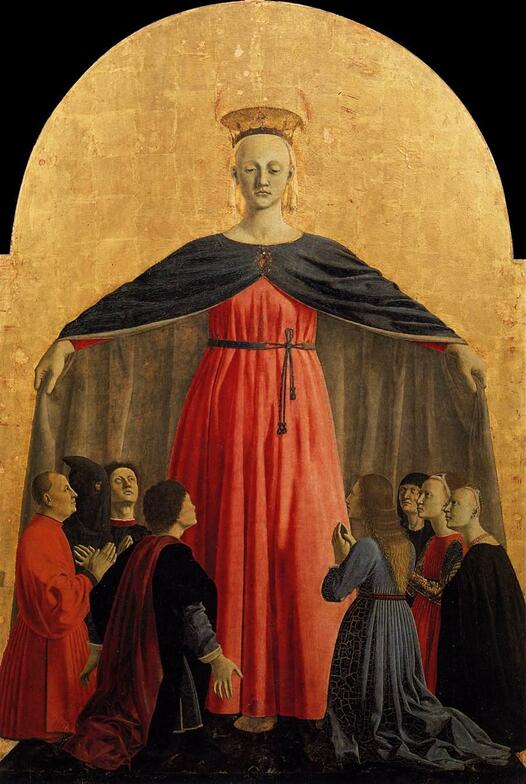
We need to offer our sorrowing world more than a Santa Claus faith. We need to acknowledge and accept the sadnesses in ourselves, and we need to give space and shelter to others who carry wounds of their own.
Traditionally, this is called Gaudate Sunday, a Latin word meaning "Rejoice." In days gone by, the more strict Advent practices lightened and people were given a foretaste of the great event to come. If we were on the Four Last Things track, we would have moved through death and judgment, and be spending this week reflecting on heaven. So, it’s a more uplifting Sunday all 'round. This Sunday, we light a candle for joy.
But the older we get - whether in years, or experience, or both - we know that joy is not the same thing as unalloyed pleasure. Joy is the gift that is deep enough and wide enough to embrace grief and sorrow. It is the deeply rooted trust in the words of St. Paul when he says: For I am persuaded that neither death nor life, nor angels nor principalities nor powers, nor things present nor things to come… shall be able to separate us from the love of God which is in Christ Jesus…."
Joy is accepting that the expression "This, too, shall pass" doesn’t just refer to hard times getting easier; it carries with it the acknowledgment that easy, carefree times will also give way to seasons of struggle, illness or worry. Joy is what empowers us to keep our head up, and our faith strong, in both.
We had, perhaps, glimpses into that kind of joy at our parish council meeting on Tuesday. When she sent us the agenda, Helen said that our ice-breaker question would be to what extent each of us had had "fun" at St. Clement’s this year. What had sounded like kind of a light and fluffy question turned out to offer shades of nuance.
People spoke about our swing dance and our fabulous St. Clement’s dinner with its international theme. Others mentioned the children’s talks we have at the beginning of the service. Then a few of us spoke about finding it hard to connect with the word "fun" in the same way that we used to - that over the years we have come to resonate more with finding a rich satisfaction in a job well done, or in witnessing others finding their happiness. And then one of us shared that she was delighted when two young extended family members attended a funeral here at St. Clement’s and, to their surprise, found parts of it 'fun.'
Our church is a place, and Advent is a season, within which we hold together with equanimity both darkness and light, both swing dances and sadness, both times when God feels far away and times when God is as close as a breath crystallizing in the cold winter air. It is a place where we can welcome children to visit with Santa one week, and then a week later bring together Jews, Muslims and Christians to collectively lament the ongoing violence and bloodshed in the middle east.
In Advent we look back to the ancient genealogy of our faith, acknowledge the joy and brokenness of the present, and look forward to the infant Christ being reborn in a world that still struggles to find room at the inn. And we look beyond that to imagine the same Christ coming again in glory, to reunite wholly and forever heaven and earth in a new Creation. We can hold all these thoughts at once, this mixture of memory and anticipation, because God’s time doesn’t move in a linear fashion but in a spiral that exists outside of human chronology. A spiral in which Christ was the Word through which all things were made as well as the Christ was the baby who whose birth changed human history.
Often in our Advent readings we hear again the words of the prophet Isaiah: "Comfort, O comfort my people, says your God. Speak tenderly to Jerusalem, and cry to her that she has served her term, that her penalty is paid."
In her book, The Meaning is in the Waiting, Paula Gooder notes that the full meaning of this passage cannot be captured in our modern English translations. "Comfort my people" is not a command made to one prophet, but to people, plural. God, she says, is crying out "Is there anyone out there who will comfort my people?"
After hearing this reference, you may have Handel’s Messiah playing in your head. In Messiah, a soaring tenor voice sings the version of this verse that comes from the King James translation of the Bible: "Comfort ye, comfort ye my people, saith your God." In Elizabethan English "ye" - as opposed to "thee" — was used when addressing multiple people. Think, for example, of the image of a town crier in the village square ringing a bell and crying "Hear ye, hear ye!"
So God is crying out for people to speak tenderly - speak to the heart of — Jerusalem, assuring them that despite the destruction of the temple, God will return and the glory of the Lord shall be revealed. And then a few verses later, Jerusalem herself, transformed by this promise, is to turn and be the bearer of good news to others: "O Jerusalem, that bringest good tidings," it says, "lift up thy voice with strength; lift it up, be not afraid; say unto the cities of Judah, Behold your God!"
And so we are back to our lesson from the children’s talk. Deacons proclaim the gospel on behalf of the church, facing not just the congregation but, primarily, the door that opens up into the wider community. It is said that the mandate of a church is to gather, transform, and send. As transformed people, we are each called to bring God’s comfort to people in our homes, workplaces and neighbourhoods, remembering that the Latin roots of the word comfort are "with strength." We are to strengthen those around us through our assurance that God is with us throughout time, and is waiting for us in a space beyond time. This is the message of joy we bring; a joy that persists through all circumstances.
The bright, multi-coloured lights and flashing Christmas displays that come with Santa can sometimes chase away a wounded soul whose heart quails before their forced cheer. But the quiet candle that lights up our Advent wreath can draw people in from the darkness of sorrow. So let us carry that warm glow in our hearts, and may we share with others the the deep joy and comfort of Christ’s coming.
***
Image attribution:
| Piero, della Francesca, 1416?-1492. Madonna of Mercy, from Art in the Christian Tradition, a project of the Vanderbilt Divinity Library, Nashville, TN. https://diglib.library.vanderbilt.edu/act-imagelink.pl?RC=55354 [retrieved December 14, 2025]. Original source: http://commons.wikimedia.org/wiki/File:Piero_della_Francesca_-_Polyptych_of_the_Misericordia_-_Madonna_of_Mercy_-_WGA17449.jpg. |